


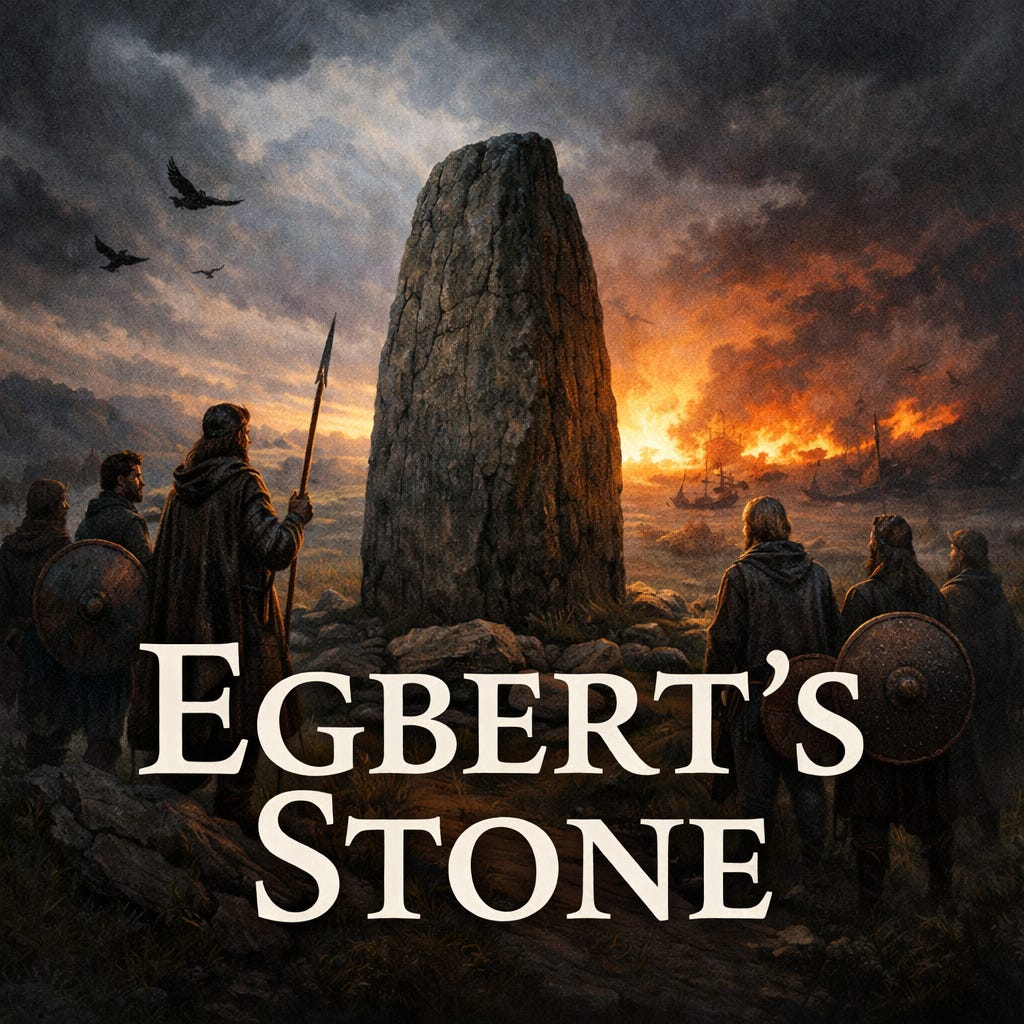
“In the same year, after Easter, King Alfred, with a few men, made a fortress at a place called Athelney, and from it with the thegns of Somerset he struck out relentlessly and tirelessly against the Vikings. Presently, in the seventh week after Easter, he rode to Egbert’s Stone…and there all the inhabitants of Somerset and Wiltshire and all the inhabitants of Hampshire—those who had not sailed overseas for fear of the Vikings—joined up with him.”1
In the year of our Lord’s Incarnation 878, the isle of Britain had almost fallen. Her grassy hills and ancient forests, once the happy resting place of humble Saxon farms, had been swallowed up in fire and shadow.
Norse invaders were the purveyors of this darkness; Oden’s awful insignia their sign of conquest and ruin. Always and everywhere they roved now like wolves: burning, breaking, raping, destroying. Under their feet almost all of Britain was sunk in darkness, and the darkness was black and terrible.
One place, however, had not yet fallen; one place had yet to bend the knee. That place was Egbert’s Stone, and here the men of Wessex found their courage.
Here they answered Alfred’s noble call, and here they gathered for war. Farmers, craftsmen, ordinary folk—not at all the stuff of legend and lore—assembled round the ancient stone and listened as their hearts were stirred by the King from Athelney. From hence they would go on to win a stunning victory at the Battle of Edington, altering the course of history forever and bringing about the birth of the English people.
Egbert’s Stone was thus the place where light was kindled once again. Love and liberty awakened here, slumbering loyalties found their vigour, and fear was trampled down. Britain was saved at Egbert’s Stone—and perhaps through her the world.
None but God can say what might have happened without the courage of these faithful few. But what can be said is wonderfully apparent to all with eyes to see: darkness is not so mighty as it seems; courage, though small, can fell the greatest foes; victory doesn’t always belong to the strongest; and love is a far more ardent force than greed.
Put simply, Egbert’s Stone reminds us that fairytales are more than tales and that unbending courage in the face of overwhelming odds is not a childish ideal but a manful necessity.
Virtue such as this was cherished once, and it was so for good reason: it was cherished because it was true; it was loved because it was noble.
The Egbert’s Stone Podcast
Recovering the virtues that built our civilization begins by first recovering a love for them. This is what the Egbert’s Stone podcast aims to do. By returning to the works of previous generations—the stories and tales that made our world—we hope to rekindle a love for the Western tradition in the hearts of the common man.
We hope to answer the cynicism and despair of the present moment with the joy and wisdom of former times.
We hope to provide stability and rootedness by tethering ourselves in some small way to the ages that preceded us.
Our culture currently regards the past with scorn—we are thankless children. Yet we owe these forgotten fathers and mothers an immeasurable debt: our world was built by their hands.
Egbert’s Stone is thus a podcast about literature and history. It is a podcast dedicated to remembering and enjoying the great stories and events that have shaped our world.
It is, in short, one more attempt to “hold a candle to this dark world”2 and exalt whatever is lovely, commendable, and true (Phil. 4:8).
We hope you listen along with us as we explore the riches of our Christian heritage.
Asser, Life of King Alfred, 84.
Rutherford, Letters, 103.
I haven't thought much about Beowulf since my college tenure as one of the most average and unmotivated English majors ever... This podcast shifted it to somewhere entirely new in my brain. I so enjoyed the insights you all cheerfully and eloquently raised. Well done!
I look forward to listening. We cannot have courage to walk in victory while we wallow in fear. Thank you!