



In the beginning God created the heavens and the earth. Now the earth was formless and empty, darkness was over the surface of the deep, and the Spirit of God was hovering over the waters. And God said, “Let there be light,” and there was light. God saw that the light was good, and he separated the light from the darkness. God called the light “day,” and the darkness he called “night.” And there was evening, and there was morning—the first day. Gen. 1:1-5
Scientists tell us the smallest components of matter in the universe are atoms. If you want to go smaller than atoms (we’re told) you’ll need to deep dive into the weird and wonderful world of quarks, gluons, leptons, and whatever allowed the Delorian to travel back to 1955.
Scientists refer to quarks and their kin as “indivisible” units; that is, they can’t be reduced to anything smaller than themselves. An uncomfortable silence should settle over the room at this point (as often does when quarks come up) which would be a great time for any Christians present to cough slightly. For there is an older, and more fundamental, component to reality than quarks.
We call them words.
Words are sounds (or combinations of characters) that symbolize and communicate meaning. In our day words have fallen out of favour but it’s impossible to overstate their power. Before God spoke there had been darkness; after, there was light. Before the British North America Act of 1867, there had been no nation of Canada; after, there was. Before Winston Churchill unleashed hell at the House of Commons on June 4, 1940, there had been no will to resist a tyrant; after, there was.
How is it that mere sounds and characters carry such weight? Well, at least partly because they aren’t just sounds and characters. They are beakers bubbling with meaning — to help or to harm. They are, in a way, spells, commanding form and agency from that which was previously formless.
Here would also be a good time to insert that although there are similarities between God’s words and ours, they aren’t equal. We can’t speak physical matter into existence nor set the fundamental bounds of its definition. We can’t, for example, command fire to not be hot, the sun to stand still, or the rain to fall upwards. Nevertheless, words remain the most powerful tool in the dominion toolbox. By means of words we woo, wed, work, and worship. By means of words we train our children to love their neighbours, fear God, and build his church. By means of words we subdue the natural world and make disciples of all nations, baptizing them in the name of the Father, the Son, and the Holy Spirit, and teaching them to obey all that Jesus commanded us.
Or we would have, had sin not ruined everything. Because of sin, man retains his subcreative abilities, but no longer offers them to God as a sacrifice of praise. He has become a damaged machine — vestiges of the original program remain, but his powers are unpredictable, and frequently destructive. He might name the animals or demand all baby boys be slaughtered. He might curse his wife or announce a benediction. He might write Anna Karenina or 120 Days of Sodom.
Tolkien comments on this terrifying reality in his poem Mythopoeia.
Man, Sub-creator, the refracted light through whom is splintered from a single White to many hues, and endlessly combined in living shapes that move from mind to mind. Though all the crannies of the world we filled with Elves and Goblins, though we dared to build gods and their houses out of dark and light, and sowed the seed of dragons, ‘twas our right (used or misused). The right has not decayed. We make still by the law in which we’re made.
We cannot escape the power of words. We cannot escape the fact that in the tongue lies all the devastation of a forest fire or a war galley. Words will inevitably flow. The only question is will they drown or nourish? Will they bless the world with truth and light? Or curse it with goblins, dark chapels, and dragon eggs.
The enfeebling agent of poison words
As an illustration of the power of words, consider the following. Recently I made a comment on the absolute state of the Conservative party, which increasingly resembles an Ikea shelving unit left out in the rain for a month. Not long after, some intelligent soul responded with the following:
Treating this as a uniquely Conservative problem misses the point. Modern politics runs on coalition signalling. Public gestures toward different groups are baseline behaviour in a system that requires constant reassurance of belonging — not proof of weakness or capture.
This. This is it.
Whether he intended to or not, this beautiful man summarized the problem that is modern politics better than I ever could have. Modern politics runs on coalition signalling. In other words, the political machine — so long untethered from truth or principle — has become so brittle, it only works if everyone equally commits to a culture of fawning and back-slapping. It doesn’t matter how insane or destructive the words may be. The system requires “constant reassurance of belonging” or it all falls apart, and you with it. Which means the constant lies, flattery, and gaslighting aren’t flaws — they’re the oil that keeps the gears running smoothly.
My commenter might be right that sycophancy isn’t a uniquely conservative behaviour. But he’s dead wrong if he thinks the following language (from a conservative) doesn’t indicate a grievous degree of weakness and capture:
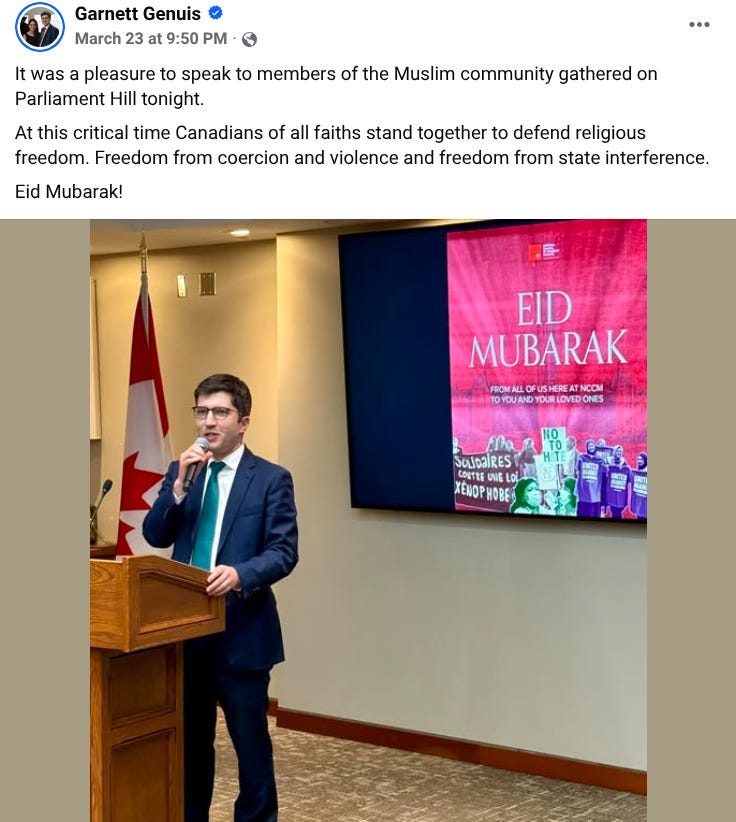
The response will come; wouldn’t it be better to just, you know, not have a fragile political system? Shouldn’t we insist on a system built on truth, sincerity, and accountability?
Lol. And again I say LOL.
Modern politics is no place for such idealism. Modern politics is for adults who understand how the machine runs and have learned to operate within it; who have run the gamut of idealism, to cynicism, to acquiescence, and finally to participation. Modern politics is for people who have come to view courage, honesty, critical-thinking, and moral clarity as downright inhibitive.
If you want to know why Canada is no longer a robust nation, it’s because we no longer have robust institutions. If you want to know why we no longer have robust institutions, it’s because they’ve subsisted on the moral equivalent of strychnine and Jello for the past sixty years. A thing can’t be stronger than its diet. If your institutions — whether a household, or a government, or a church — are fed with poison, they’re not going to be strong.
They’re going to be dead.
I’m not here arguing for a powerful state. I’m arguing for a state that exists for more than the perpetuation of itself. I’m arguing for a state that’s actually able to do its job without sucking the life from its host. And I’m arguing that the state can only do this when it knows what its job is. Without a fixed point, our definitions become whichever way the winds are blowing. We’re left with pragmatism, power dynamics, and coalition signalling.
This is what “modern politics” has become. A feedback loop. A self-reinforcing parasite. A porcelain doll in a hardware store during a magnitude 8.0 earthquake.
In the beginning was light …
It’s interesting to note that in the absence of the Word, words haven’t disappeared. In fact, they’ve multiplied. But because these words are rife with lies, it’s the kind of multiplication that ultimately results in a subtraction. Like multiplying cinder blocks in a rubber life raft.
Decisions are no longer made by directly confronting problems, but via endless “dialogue” and circumlocutory memos. Conflict takes place within an ecosystem of emotional cues, complicated hierarchies, and “sussing out” who will be hurt by what course of action. Right and wrong are determined not by direct appeal to facts, but by signalling the virtue of one’s tribe. The goal is not to arrive at truth but to evade blame while shaming one’s opponents. Evil is no longer identified, it is euphamized. Lies are no longer rebuked, but welcomed as old friends. Blasphemy has become liturgy. Words ought to be a means of life. In our sin and pride, we have enlisted them as agents of death.
The mess that is modern politics should be instructive to Christians.
In the beginning there was nothing. And then God spoke. His words alone were able to take a cataclysm and transform it into an environment of flourishing domesticity. If we want to build resilient churches, households, and institutions, we must return to the blueprints. We must return to the place where dark is made light. We must return to the words of Christ and the word that is Christ.
"The Spirit breathes upon the Word,
And brings the truth to sight;
Precepts and promises afford
A sanctifying light.

A glory gilds the sacred page,
Majestic like the sun:
It gives a light to every age;
It gives but borrows none."

- William Cooper, 1779