


I try to avoid being relentlessly … relevant … here at Balaam’s Ass.
Part of this is by design, due to the increasing disconnect between today’s “urgent” headlines and the kinds of things that actually deserve urgency. As a case in point, a recent cover story featured on CBC’s website1 featured an ex-olympic athlete who spent the last five years recovering from the trauma of “invasive camera angles.” The other part is accidental — “irrelevance” being, apparently, an irrevocable genetic feature. In my defense, I’m positive the raw materials for Mr. Olympia 2032 are also in there somewhere.
This week, we’re going to attempt something of a hybrid. Yes, I want to talk about Lindsay Clancey. Not simply because she happens to be on the public mind, but because the public mind has apparently been dropped on its head when it comes to thinking sanely about her actions. But I want to do so … constructively, if that makes any sense.
We’re going to get there. But we’re going to take the scenic route.
When you banish blood and iron
Any young boy who’s ever read any story involving King Arthur and his knights will recall the disappointment — yea, betrayal — upon realizing that distressed damsels feature in them at least as largely as dragons and castles. Up until about the age of twelve, I had always assumed these to be exclusive categories. One could be devoured by dragons or devoted to a lady; one could not do both. It turns out the problem was not with the stories, however, but with me. When I was a child, I thought as a child, and as a child, I largely thought in terms of reductionisms. A man could either be strong or gentle; heroic or homebody; meek or murderous.
Paradoxes are bewildering, fearful things for children. And apparently for many adults as well.
The truth, however, is that the only men qualified to sit around Arthur’s round table were men of paradox; who were just as at home on the battlefield as they were in the nursery. “Thou wert the meekest man”, Sir Ector said to the dying Lancelot, “That ever ate in hall among ladies; and thou wert the sternest knight to thy mortal foe that ever put spear in the rest.” Men like Lancelot could be relied upon to pull a chair out for Lady Dandelion just before before politely excusing themselves to go pull off someone’s arms.
These were not members of some proto medieval bipolar support alliance, but practitioners of the ancient art of chivalry. Originally established to govern the behavior of mounted warriors during the 12th and 13th centuries, its core ideals would gradually evolve into an entire chivalric code which included bravery, military prowess, loyalty to lords, defense of the church, respect, courtesy, and generosity toward the weak. In Lewis’ words:
[Chivalry] brought together two things which have no natural tendency to gravitate towards one another. It brought them together for that very reason. It taught humility and forbearance to the great warrior because everyone knew by experience how much he usually needed that lesson. It demanded valour of the urbane and modest man because everyone knew that he was as likely as not to be a milksop.
The chivalric man “is not a compromise or happy mean between ferocity and meekness; he is fierce to the nth and meek to the nth.”
We don’t like our boys learning from men like Arthur anymore. Or Jesus, for that matter. Such figures, we are told, were narrow and savage — liable to waken a slumbering gallantry that half-a-century of public education has taken such pains to breed out. Today, we prefer our heroes salsa suave. Like the bald, French-Canadian baby, Caillou, who, in a just world, would have fallen into a swamp around episode two and been devoured by caimans. Contrary to popular opinion, the expulsion of knights from the public sphere hasn’t made the world a less-savage place.
As we turn to the trial of Lindsay Clancey, we see it has become something much, much worse.
Neo-savagery
Recently a woman who strangled all three of her children was nearly acquitted, and no doubt soon will be. Why? Because, at least according to eleven of twelve jurors, mentally-unstable women should never be held accountable for their actions.2 As if the only truly guilty murderers are the ones who kill people from a place of limpid mental clarity.
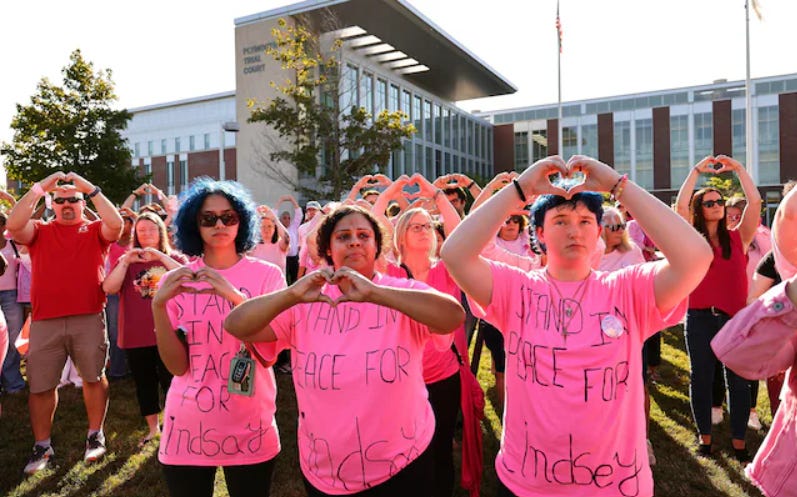
But even more shocking than the murders themselves were the responses to the one man who refused to bend. “He had the hardest time getting off the fact that Lindsay viciously killed her children,” one juror said. “He was very arrogant,” another said. “He really did not take anything that anybody said.” Out of twelve people, only one man refused to join the bacchanalian orgy of suicidal empathy. Only one man dared give a thought to the true victims; not Lindsay Clancy, nor the hordes of blood-thirsty Maenads who gathered outside Plymouth Superior Court in pink shirts. But three murdered children lying in the cold ground.
To understand these responses, we need to understand that in a culture shaped by decades of feminist ideology, no greater sin now exists than the refusal to participate in consensus. The knight, bound by principle, represents a contrarian force that cannot be tolerated, as evidenced by mainstream media’s collaborative smear campaign. The real villain in the story is in no doubt: The Single, Male Juror.3
With decades of imagined grievance having been administered to the female psyche, it isn’t difficult to imagine the kind of precedent such an acquittal would provide. We have already awarded them the lives of the unborn as reparations. Did we actually think they would stop at the recently born? This is, by the way, where victimhood culture always ends — with no crime too extreme to justify.
Lewis, in his essay, The Necessity of Chivalry notes:
If we cannot produce Launcelots, humanity falls into two sections—those who can deal in blood and iron but cannot be “meek in hall”, and those who are “meek in hall” but useless in battle—for the third class, who are both brutal in peace and cowardly in war, need not here be discussed.
The demographic that Lewis here precludes from discussion is precisely the environment in which a woman like Lindsay Clancy is allowed to walk free. We who have banished men of paradox — whose meekness manifests in a refusal to comply — who forbid judgement on murderers, and justice for the murdered; who glory in our empathy while rinsing blood from our hands; who are brutal in peace and cowardly in war. WE are the third class. In our haste to cleanse the world of perilous heroes, we have flung the door open for the pagan savagery they fought against.
One man — one knight — prevented a travesty. Imagine what all three of them could have accomplished? I sincerely hope the two other “Brave Sir Robin’s” that folded like a tin shed went home and drank a celebratory Cosmopolitan in honour of their transitions.
And may God raise up, and help us be, men of deadly paradox.
Which, incidentally, was recently redesigned using what I can only assume was a combination of monkeys, Jose Cuervo, and 1988 Macintosh MacPaint’s entire suite of FOUR (count ‘em!) dedicated geometric shapes. See for yourself!
Conveniently, Clacey was only diagnosed with postpartum psychosis (as opposed to depression) after the killings. Convenient!
Who, in an exquisitely ironic development, happened to be black.