


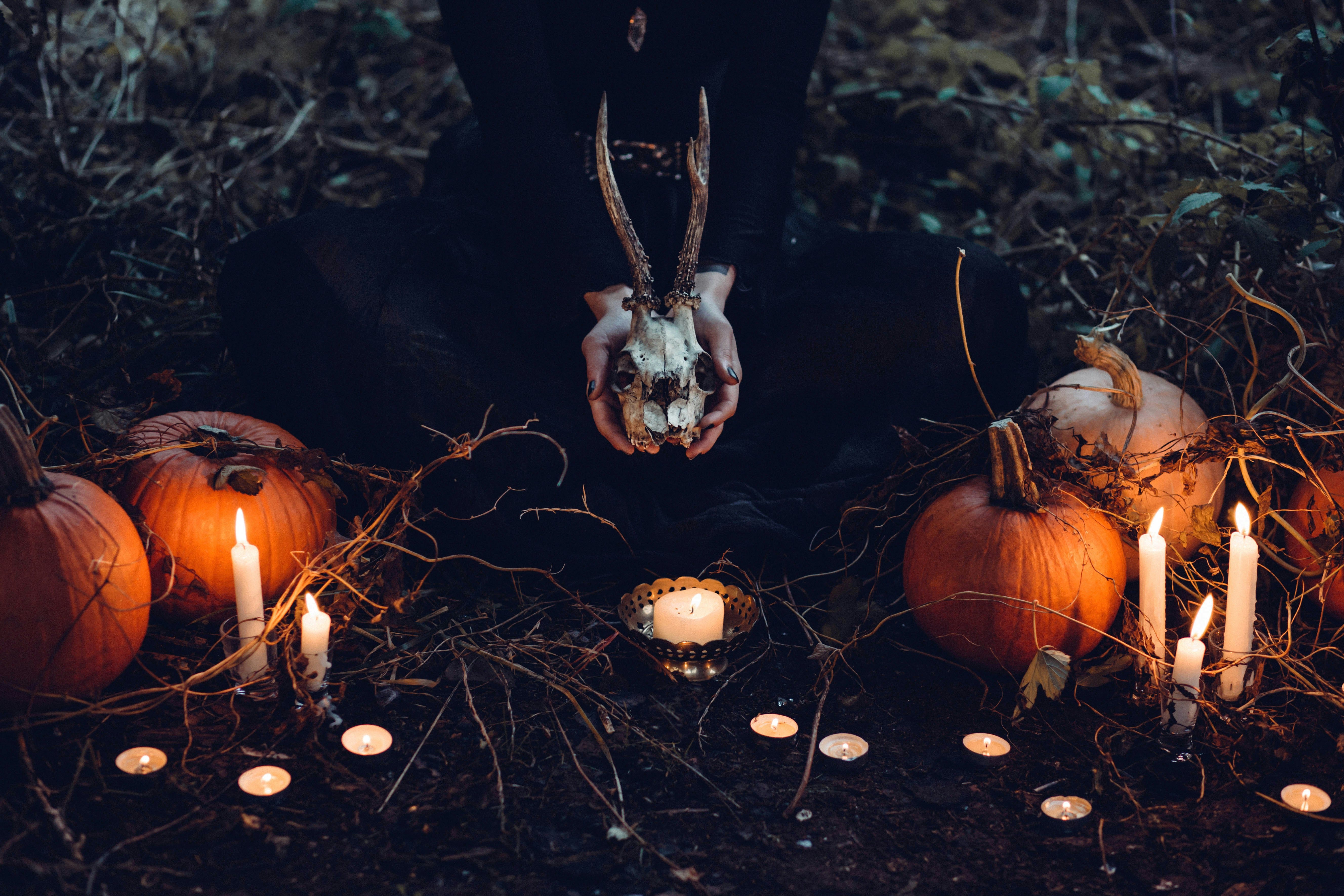
Once again the season of ghosts and ghouls is upon us. And globalists. Don’t forget about those terrifying spectres.
And still more horrors await! There are Those Who Take The Entire Weekend To Snarl Their Emerald Cedars In Magenta Webs. And don’t forget Those Who Spend Thousands On Inflatable Lawn Ornaments — like the giant pumpkin from which various members of the Paw Patrol emerge to terrify the living. Scariest of all, however, might be the geyser of articles that detonates every October in and around certain Christian circles. Articles such as “Concerning The Dispersement of Candy,” “Is a Christian Permitted to Dress Up As Bulwinkle?” and “The Ethics Of Dropping One’s Blown-Out Pumpkin On Mrs. Addaway’s Prius,” frequently go on to haunt media network archives long after the festival itself has ended.
So why in the Samhain am I writing another one?
Honestly, and even mainly, because a lady at our church wanted to know what her pastors thought about the whole thing. And here can I just pause and say you’ll never know how much it makes a pastor’s day to hear those words. Not because we’re crippled with insecurities, but because in a world of online pastors, podcasts, and posers, it’s encouraging to know there are still Christians who prioritize the unspectacular, but God-ordained, means of the local church.
What follows are several principles I hope might help Christians as they work through the whats and hows of Halloween.
Bobbing for baklava will take place afterwards in the library.
The earth is the Lord’s
In discussions about Halloween, the question of origins inevitably comes up. The thinking here is that locating the particular circumstances of Halloween’s inception should help us determine whether we endorse or condemn it. The problem here is that the customs and traditions that do manage to survive the gauntlet of centuries rarely arrive at us bearing any resemblance to their original form and function.
And Halloween is no different.
Originally, November 1st marked the ancient Celtic festival of Samhain — the official end of the harvest season and the start of their new year. The night of the 31st was viewed as a kind of liminal space in which the boundaries between dead and living grew thin. Villagers would light bonfires and dress up in animal skins in the hopes of confusing whatever nearsighted interdimensional beings might want to crash their parties.
Fast forward to the 8th century, as Pope Gregory III decides to mark November 1st “All Saints’ Day” in honour of past saints and martyrs. The evening before — October 31, the day on which Martin Luther would eventually nail his 95 theses to the Castle Wittenberg door — becomes known as All Hallows’ Eve, which will eventually be shortened to Halloween. November 2 becomes All Souls Day, in which Catholics would observe various masses and prayers for departed loved ones, along with bonfires, parades, and dressing up in costumes. The whole thing became part of a three-day calendar event known as “Hallowtide.” 19th-century Irish and Scottish immigrants would eventually bring these customs to North America, where the holiday grew into the widespread cultural celebration it is today.
So there you have it. Two possible origins of Halloween; one pagan, one Catholic. Who deserves custody? Never mind whatever debasements my Scotch/Irish ancestors inflicted on it. Never mind that as a Protestant I find both traditions equally offensive. I’m not dressing up as a goat to ward off my great Uncle John’s ghost, and I’m certainly not going to start praying for him.
Here, it might be helpful to visit Paul’s discussion of food in 1 Corinthians 10:23-32:
23“All things are lawful,” but not all things are helpful. “All things are lawful,” but not all things build up. 24 Let no one seek his own good, but the good of his neighbor. 25 Eat whatever is sold in the meat market without raising any question on the ground of conscience. 26 For “the earth is the Lord’s, and the fullness thereof.”
In this passage, Paul argues that meat in itself is incapable of corrupting anyone. That it might have been offered to idols at one point does not render it dangerous for Christians. The earth, being the Lord’s, means demons do not have ontological jurisdiction over meat. Paul makes a similar argument in Colossians when it comes to prioritizing certain days (sabbaths, festivals, etc.) over others.
How does this relate to Halloween?
To start, we ought to view October 31 as a day like any other. Neither Celts nor Catholics have the power to bestow power on any one day over another. Which means the boundaries of death are no less impermeable on October 31 than they were on the 30th. Which also means those who have died are neither more nor less improved by prayers offered on October 31 than those offered on February 14. Days, like food, belong to the Lord. No power exists, in heaven or on earth, that can imprint its ownership on any part of creation.
So unquestionable is the dominion of Christ that even pagan elements may find themselves redeemed under his yoke. Christmas trees, for example, are almost certainly an amalgam of Egyptian, Early Roman, and Celtic superstition. Yet most homes today, including Christian ones, include some version of evergreen in their advent observance. Why? Because the earth is the Lord’s and everything in it. Everything, including evergreens, belong to him. Which means, incidentally, that they also belong to us. And what could be more symbolic of advent than a living tree, blazing with light, in the midst of a dark and dead season?
To bring this all back to Halloween, it means there is nothing inherently preventing Christians from dressing up on October 31, enjoying some shivers (remind me to tell you about the shivers someday), and handing out some malt balls to the neighbors. You may choose to lock the doors and turn the lights off because you’re not interested in awarding tootsie pops to playboy bunnies and pit demons. But you shouldn’t do it because of some notion of it being “Satan’s Night.”
No such thing has ever existed. Or ever will.
Not so fast
Now, just because you may observe a festival, the question remains: should you?
Does the earth being the Lord’s mean that Christians are permitted to always and forever embrace anything the earth offers? Emphatically, no. Beyond the fact that there are objective evils that should always be avoided (cocaine for example, and marmite) there are things that may be rendered unwise, or even sinful, depending on the context.
Let’s go back to 1 Corinthians 10:
27 If one of the unbelievers invites you to dinner and you are disposed to go, eat whatever is set before you without raising any question on the ground of conscience. 28 But if someone says to you, “This has been offered in sacrifice,” then do not eat it, for the sake of the one who informed you, and for the sake of conscience— 29 I do not mean your conscience, but his.
We’ve already established that meat has no inherent capacity to corrupt. Circumstances, however, may change that.
If the host suddenly says, “Hey, by the way I offered this to Molech earlier,” this changes things for the Christian. Not because the meat has changed ownership but because circumstances around the meat have changed. The host may well be shaken at the Christian who shrugs and starts stuffing his face anyway. Going forward, his conscience may be seared into thinking there really isn’t that much difference between demons and Christ after all.
So, it is possible for something inherently neutral, that would normally be completely acceptable for a Christian, to become not acceptable in another context. As the Pulpit commentary notes, “Difference of time and circumstances necessarily involves a difference in the mode of viewing matters which in themselves are unimportant.”
When I was young, I went out for Halloween. One year I dressed up as Robin Hood. Another time I went as a Turkey Vulture, which involved stapling about twelve dozen construction paper “feathers” to a musty old blanket. I remember grabbing a pillowcase and going out with my parents, or some friends, to visit various neighbors and neighborhoods we knew. Amazingly, there was even one lady that made her own lollipops, which our parents didn’t immediately require us to throw out (that was reserved for the truly awful halloween “toffees”). Most houses had a simple lit jack-o’-lantern, some threadbare cobwebs, or a scarecrow.
This has changed.
Visit your nearest Home Depot and you can choose between a nine-foot tall hooded demon, a possessed animatronic doll with her mouth sewn shut, or a chainsaw-wielding clown in an advanced stage of decay. An increasing number of houses around our city are transformed into elaborate murder/torture scenes for the entire month of October. Human-sized figures wrapped in blood-stained sheets hang from trees, swaying gently in the breeze. For weeks, death, murder, and all manner of cruelty are portrayed in a spirit of campy celebration.
Perhaps a case could once have been made for costumes and decorations as mediums of defiance — a way to mock the evil that Christ had overcome. Such is no longer the case. From my vantage point, it is evident we are not rebuking anything. We are joining in with it. We are announcing our solidarity. We are declaring our allegiance.
But beneath the decorative elements themselves, a more subtle demonism is at work that is far more deadly: the trivializing of evil. When the child walking home from school sees a mannequin on a stretcher getting his entrails pulled out by a zombie nun, next to a happy little leaf-bag pumpkin, what is he meant to infer about evil? Lol. Rofl, even. The conscience of the observer, though perhaps initially violated, merely assumes a latent prudery in himself has been cured. Look how mature and unfazed he has become in the face of horror.
As Christians have become more worldly, we have forgotten that one of our main callings is to be light. And light, as Paul notes, has no fellowship with darkness. It exists to expose and embarrass darkness. When light joins in with dark, it ceases to be light and eventually becomes dark itself.
Circumstances being what they are, I can honestly say Halloween is no longer something I can comfortably participate in. As Christians, we are to avoid the appearance of evil. As the world becomes more and more normalized to depravity, what it will increasingly need is a basin of cold water in the face, in the form of Christians simply not participating in its debased, dysfunctional mechanisms.
Positively, Christians should respond with festivals of light — observing and celebrating those events that deserve celebration. There may yet be a day when Halloween can be dusted off and recovered. Until then, why not remember the rehabilitated German monk who lit the fuse that sparked the Reformation? Seize the solas. Sing the Psalms. Rejoice in the triumph of light over dark.
Now that’s something to celebrate.
I loved this witty & pastoral explanation! So well done. Thank you for writing it, I’m certain it will be helpful to the people your church as well as many others.
Our church does something like what you encourage in the final paragraph — we call it Family Fall Festival. We join to celebrate the Reformation on October 31st in the evening, the children are invited to dress up as godly biblical figures, reformers, saints, or wholesome characters who clearly represent good, and we hand out the BIG candy bars along with our own Gospel tracts to the community and have conversations with parents who bring their children trick or treating. It’s our way of bringing their light into a darkened, Christless community and engaging with the culture instead of hiding in our homes with the blinds shut and lights off.
This was an Interesting morning read. I liked Halloween as a kid (free candy, who would not)? Now, as you point out, it has become far too macabre. As a child, we put a pumpkin in our window. That was it. I usually don't engage much with the day any longer (we have rarely had children at our door, although we did take my daughter out as a child: Disney Princess, Lady Bug, Cute little witch, Tigger, were among the more memorable costumes.
I am going to an event, as hubby is hunting and I thought, why sit alone with the lights off. The theme is "creatures of the night." I wracked my brain until I came up with the idea for an owl costume. I will be surrounded by some pretty out there costumes, no doubt. This increased obsession with the "holiday" points to some underlying need in our society for something to celebrate, even as the society turned/turns away from Christ. Having said this, I think there has been a turning point, with reports of Bible sales and church attendance way up. The light will conquer the darkness as we know. It is the getting through the darkness that is the challenge.
Am I still going out? Yes, that remains more appealing than sitting alone in the dark. But, thank you for your balanced take on the subject.